
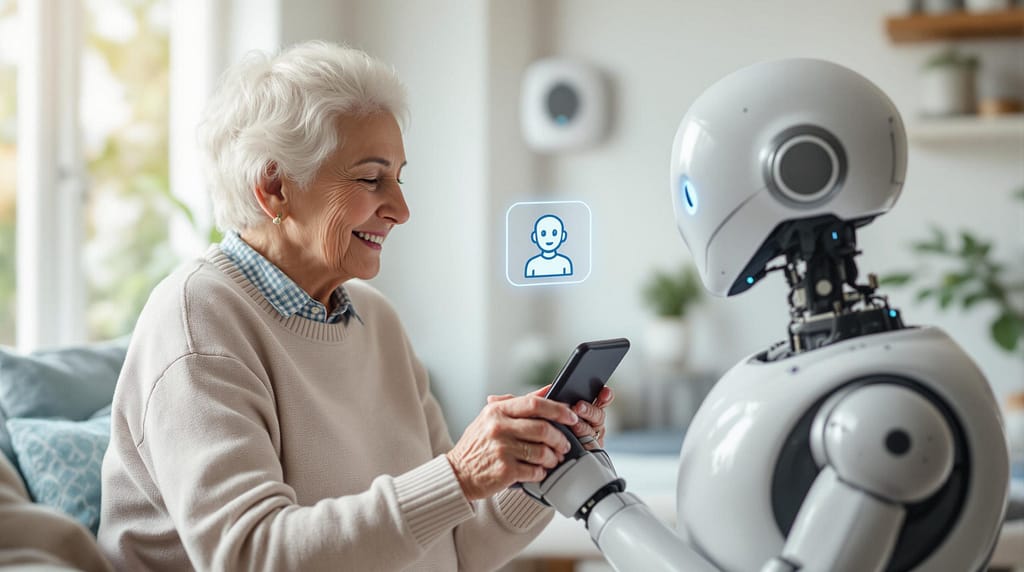
Top AI Innovations and Developments in UK Elderly Care

1. Can AI Care for Your Loved Ones in Their Old Age?
The UK care sector is increasingly adopting AI technologies to support its growing elderly population. From pain-detecting apps to overnight monitoring sensors and training robots, these innovations are changing how care is delivered. At Elmbrook Court care home in Oxfordshire, carers use the Painchek app to scan residents’ faces for pain indicators, particularly helpful for non-verbal residents. Meanwhile, AllyCares sensors monitor care home residents overnight, reducing preventable hospital admissions by detecting issues like falls and chest infections early.
Oxford University’s Robotics Institute has developed a robot that reacts to human touch, programmed to feel pain in different body parts and physically flinch when touched too forcefully. This “digital twin” will be used to train occupational therapists at Oxford Brookes University. Despite these innovations, experts like Dr. Caroline Green from Oxford’s Institute for Ethics in AI caution that “AI can only be part of the solution but not the whole solution,” highlighting concerns about bias, data privacy, and the need for continued human interaction.
2. For £25 a Month, an AI Bot Will Call Your Elderly Parents
A new service called inTouch offers daily AI phone calls to elderly parents for £24.90 per month. Created by former Microsoft executive Vassili le Moigne, the service aims to combat loneliness among older adults by providing regular check-ins, engaging conversations, and reporting back to family members on their well-being.
With nearly 1.4 million people aged 65 and over experiencing chronic loneliness in the UK, and around 225,000 older people going an entire week without speaking to anyone, the service addresses a significant social issue. However, the technology raises questions about the balance between technological assistance and human connection. As one user’s mother noted after trying the service, “Instead of going further into screens and technology, talking to robots, it really should be going the other way around.”
3. AI in Social Work: Opportunity or Risk?
The social work sector is adapting to the impact of artificial intelligence on its operations, with more than one in five social workers already using AI tools like Microsoft’s CoPilot or Beam’s Magic Notes for daily tasks. These tools can transcribe and summarize assessments, generate actions, and retrieve information from case management systems, potentially reducing administrative time and allowing more focus on direct work with clients.
However, researchers and practitioners are wrestling with ethical dilemmas, including data privacy concerns and the risk of AI tools replicating biases present in their training data. Dr. Tarsem Singh Cooner from the University of Birmingham notes, “There are benefits to it as long as you use tools with a critical eye,” emphasizing that social workers need to understand concepts like AI bias and “hallucinations” where programs present inaccurate information as fact. The British Association of Social Workers has published practice guidance advising practitioners to avoid entering sensitive personal information into generic AI tools without explicit consent.
4. More Than Just Hype: How AI is Assisting Health and Social Care
AI technologies are being developed, tested, and implemented across NHS and social care settings to improve working conditions and reduce staff workload. AI scribes (also known as ambient voice technologies) are being used to record, transcribe, and summarize consultations, reducing cognitive burden on healthcare professionals and allowing them to focus more on patient care.
These tools are being tested in various settings from outpatient services and general practice to home care and residential care. While clinical opinions on time-saving benefits are mixed, there’s potential for future AI scribes to go beyond standard consultation support by suggesting follow-on actions, identifying training needs, and improving inclusivity through translation services. Some ambulance services are also exploring whether ambient voice technologies could alert managers when call handlers have had particularly difficult days, potentially improving staff wellbeing and retention.
5. The UK Just Trained a Health AI on 57 Million People to Predict Disease
The NHS has granted researchers at University College London and King’s College London access to eight routinely collected datasets covering 57 million people to develop an AI system called Foresight. This ambitious project aims to predict health risks before they manifest, potentially transforming preventative healthcare in the UK.
The system will analyze patterns in health data to identify which combinations of health circumstances often result in illness or deterioration, such as when frail people are at risk of falls. Once fully trained, Foresight could enable the NHS to proactively contact high-risk patients before conditions worsen. The project operates within NHS England’s Secure Data Environment, with patient data remaining under NHS control to address privacy concerns.
6. AI Tools Improving Patient Care in the NHS
NHS clinicians are benefiting from AI tools that reduce bureaucracy and take notes during consultations, freeing up staff time and enabling better patient care. These tools are part of a broader initiative to harness technology to address the significant administrative burden faced by healthcare professionals.
By automating routine documentation tasks, these AI systems allow doctors, nurses, and other healthcare staff to spend more time on direct patient interaction and clinical decision-making. The technology is particularly valuable in primary care settings, where administrative workload has been a major contributor to burnout and staff shortages.
Read more at National Health Executive
7. Fresh UK-EU Collaboration on AI to Unlock New Avenues for Innovation
Building on the UK’s new deal with the EU, plans have been launched to enhance AI collaboration across Europe, with potential benefits for healthcare and social care sectors. This international partnership aims to accelerate the development and implementation of ethical AI solutions that can address common challenges in aging populations.
The collaboration will focus on sharing best practices, aligning regulatory approaches, and jointly funding research initiatives that explore AI applications in healthcare delivery, preventative medicine, and support for independent living among elderly populations.
8. How AI is Transforming Work for Doctors at Hull’s Jean Bishop Centre
Doctors at Hull’s Jean Bishop Centre are using artificial intelligence to offer more personalized care and reduce the risk of staff burnout. The AI systems help analyze patient data, suggest treatment options, and handle routine administrative tasks, allowing healthcare professionals to focus more on patient interaction.
This implementation demonstrates how AI can be effectively integrated into existing healthcare workflows to benefit both patients and staff. The technology is particularly valuable in supporting complex care needs of elderly patients with multiple conditions, helping doctors identify patterns and potential interventions that might otherwise be missed.
